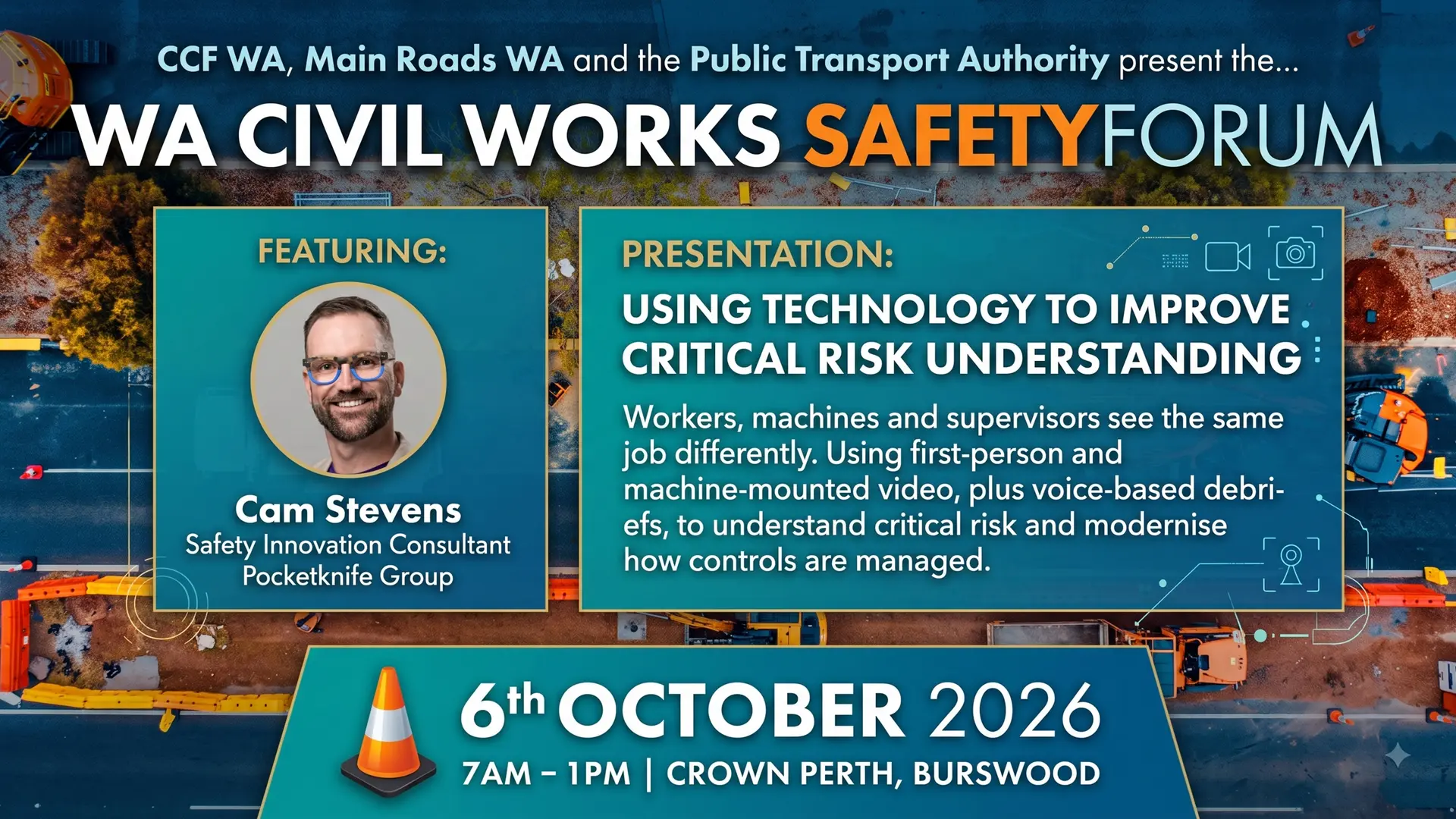
This year’s WA Civil Works Safety Forum brings together civil infrastructure safety professionals and works supervisors/managers to share and learn information on new developments and best practice in safely managing civil construction and maintenance projects – and to network with their peers.
Event: WA Civil Works Safety Forum
Session: Using technology to improve critical risk understanding
Presenter: Cam Stevens, Managing Director, PKG Safety Innovation
Host: Civil Contractors Federation WA (CCF WA)
Date: Tuesday 6 October 2026
Location: Crown Perth, Western Australia
PKG Safety Innovation™ was invited by CCF WA to present at the 2026 WA Civil Works Safety Forum, a half-day gathering of civil infrastructure safety professionals, supervisors and project leaders. Cam Stevens’ session explored a simple question: whose view of the work are our critical controls built on?
Inspiration from Hollywood
The session opened with a 1947 detective film. Lady in the Lake was shot almost entirely from the detective’s point of view, one of cinema’s earliest attempts at sustained first-person perspective. From there the clips moved through Jaws, the first iPhone, the origin of GoPro and pocket sized drones.
Filmmakers have spent the best part of a century learning that where you put the camera changes what an audience feels and understands. Safety has been slower to borrow the lesson. Most of the people designing management systems and critical controls aren’t the people doing the work, and very few of us have looked at a critical risk from the machine’s side. Like the shark in Jaws, the hazard has a point of view too.
Where you put the camera decides understanding
The core of the session was a continuum of perspective. First person (I’m doing the work) uses head, chest or smart glasses cameras to help viewers feel the task, including how close hands and bodies come to the line of fire. Second person (I’m talking to you) is the selfie-style talk-through, where a worker explains the sequence and the critical step they’re about to take. Third person (I’m watching the work) is the supervisor’s view. The system view (I can see how it all fits together) comes from drones, crane hook cameras, CCTV and time-lapse, and turns the viewer into an analyst of layout, flow and traffic management.
Thirteen examples from real workplaces brought the continuum to life. A 360 camera and spatial audio let the viewer hear plant approaching from behind and turn to see what the worker missed. A camera on a paver showed what the operator can and can’t see. A “day in the life of a forklift” counted how often people cross into its path. A hook-mounted camera showed who stands beneath a suspended load, and CCTV time-lapse in a quick-service kitchen revealed that the most-used cup size was stored in the least accessible spot.
Before showing any of it, Cam asked the room for one thing: “View with no judgement. You’ve been invited into someone else’s workplace, and that’s a privilege.”
Comparing work as imagined with work as done
Combining perspectives is where video becomes useful for critical risk. A supervisor narrates what the steps should be, the worker talks through what they’re doing on a chest-mounted camera, and someone reviews both against the written procedure. The differences are the finding.
AI makes this practical at scale: transcribing workers’ voice notes and toolbox talks, and finding the moments that matter in hours of footage. One pattern comes up again and again in this kind of review. The conditions changed, and the original control didn’t change with them.
Trust comes first
Digital work capture without a plan creates risk. Picking up on Greg Smith’s earlier session on contractor safety management and legal exposure, Cam’s advice was direct: if you’re not going to analyse it, don’t collect it, and be comfortable deleting footage once it has served its purpose. Reusing existing footage, such as running AI over CCTV recorded for security, is a new purpose and needs fresh consultation. Get it wrong and you disenfranchise your workforce and lose the licence to use cameras on site at all.
The reason to do any of this is to design better work. The recommended starting point was deliberately small: one critical risk or one task, viewed from a few perspectives, perhaps with voice reporting, then reviewed with the crew so that together they co-design one change.
What we heard from the panel
In the closing panel, Rob Orelj (FSC Civils) warned that AI could take the industry backwards before it moves forwards, with a flood of quickly generated procedures that never reach, or make sense to, the people doing the work. He also argued that psychosocial safety has to move beyond mental health programmes and into work design. Anton Piccinin (Saltire Infrastructure) described one-page, picture-led delivery standards for underground services that work regardless of language or literacy. From the client side came an AI camera trial on a major river crossing project that alerts supervisors when people and plant come too close.
Cam’s own reflection drew on Stephen Broad’s session on neurodiversity. Our workers are not standard, so why would we design one way of working for everyone to follow? The next opportunity is to set standardised control expectations and deliver them in a personalised way, across psychosocial hazards, silica exposure and plant interaction alike.
Thanks to CCF WA for the invitation, and to the clients who let us share footage from their workplaces.
If you’re thinking about using video or AI to understand a critical risk on your projects, most of our engagements begin with a conversation. Book a discovery call.