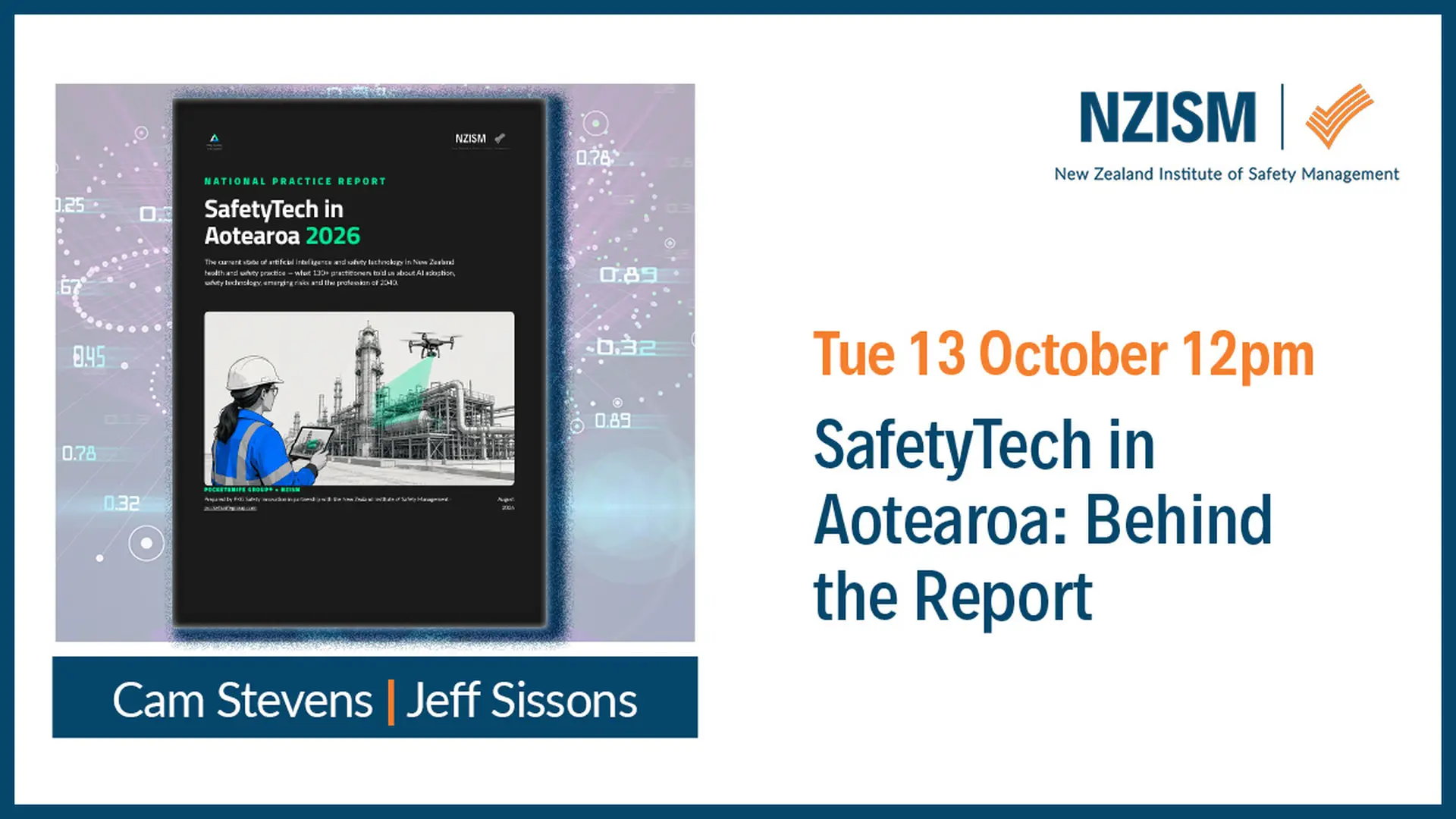
A conversation with Jeff Sissons and Cam Stevens.
In July and August, Cam Stevens delivered NZISM's SafetyTech in Aotearoa workshop series, bringing more than 150 safety professionals together in Christchurch, Wellington, Auckland and online to explore AI and safety technology.
Throughout the series, participants shared insights, ideas and experiences, which have been brought together in a national report on the current state of AI and safety technology in New Zealand health and safety practice.
Join Jeff and Cam as they go behind the scenes of the report. They will give an overview of the key findings, talk through the insights and themes raised in the workshops, and discuss what they mean for safety professional practice in New Zealand.
Event info: www.nzism.org/event/eventpage/28a94a75-6bd2-44fa-b434-aff8667607d2
Date: Tuesday 13 October 2026 from 12:00pm to 1:00pm NZST
Location: Online
NZISM's 2026 national roadshow took AI and safety technology to Christchurch, Wellington, Auckland and online. Two months after the final session, NZISM Chief Executive Jeff Sissons and Cam Stevens sat down with members to talk through the national report: what more than 130 practitioners told us about AI adoption, safety technology, emerging risks and the profession of 2040.
Learning to surf
Jeff opened by explaining why NZISM chose AI and safety technology for this year's roadshow. AI is moving fast. It brings real productivity and safety benefits alongside real risks, and informed users get more of the first and less of the second. In his words, “a tidal wave is here, so practitioners either learn how to surf or they get washed under.”
He named two questions the profession has to wrestle with: how AI can support professional judgement without supplanting it, and how to stop it stunting the development of junior practitioners whose entry-level work it absorbs. NZISM also wanted a roadshow topic that would challenge its most senior members as much as its newest.
Read the data as a signal
Cam was upfront about the limits of the data. People who pay to attend an AI roadshow and complete an AI questionnaire are more engaged than the profession at large, and the facilitator was both sharing views and collecting the data. The report is best read as a signal: a line in the sand at one point in time.
Jeff asked whose voices were missing. The sample had a good spread, from large industry and government to the regulator, practitioners and senior executives. The gap is the people who are wary or concerned but not motivated to learn. Cam sees real topic fatigue here; so much of the AI conversation is thin that it risks disenfranchising the very people the profession most needs to reach. Smaller, tighter-knit conversations, such as regional sessions, may be where that happens next.
Come to the table with a view
68% of practitioners surveyed use AI regularly or as standard practice. Close to half report an AI policy, far fewer know how to put it into effect, and eight in ten organisations don't measure whether AI is delivering any value.
Asked how members can raise this with leadership, Cam pointed to a policy that is ageing fast. Most organisations wrote an early rule along the lines of “only use approved tools”. AI is now embedded in safety management software, accounting, HR and work order systems, so that line carries less weight every month. Safety practitioners should take stock of where AI is being used, or could be used, in their area, then go to IT and senior leadership with a view on the hazards, risks and opportunities. “Generic guardrails don't typically fit the types of work we're wanting to apply AI for in safety,” Cam said, particularly where personal information and behavioural data are involved.
The skill is now providing a quality brief for AI
Much has changed since August. Early training focused on which button does what; the major platforms have since simplified, and many of the toggles shown during the roadshow have gone. The skill now is writing a competent brief, the way you would brief a colleague, and letting the AI decide how to do the task. Global instructions, written once, do much of what prompt engineering used to.
That shifts the emphasis to human skills: thinking about your own thinking, judging the quality of an output, and holding the context the AI doesn't have. AI can suggest an engagement approach for a difficult site conversation. It doesn't know the supervisor. You do.
Checking everything doesn't scale
Today's dominant control is “you own it, you check it”. Cam described a recent PKG project that used AI to extract control tables from around 2,300 procedures for bow-ties and critical risk registers. The AI took seven or eight hours. Checking every output properly would take months, so the team uses confidence colour-coding and directs human review to the amber items. “Is that risky? Maybe. But this is the world we're starting to move into.”
When a participant queried a report reference on one of the slides, Cam used the moment to make a broader point. Some errors are embarrassing and reversible, and checking every reference on every slide may not be worth the effort. Safety-critical outputs are a different matter; oversight should scale with the consequence of getting it wrong. Independent models cross-checking each other, and confidence scores that direct human attention, are already part of the toolkit. Cam's prediction: in 2027, “AI error” will start to appear as an incident category in safety software.
You can't have your cake and eat it too
Deskilling and loss of critical thinking drew 39% of hazard votes across the roadshow, the top concern by a distance. Yet the profession's main control is to check everything. Cam put the tension plainly: “You can't say that we need to check everything but also, over time, lose our skills. That's a race to the bottom.”
He was candid about his own experience. His output with AI is an order of magnitude higher, and it's harder to recall the detail of content he didn't write by hand. Experienced practitioners can lean on deeply embedded skills; a new practitioner who has never built a timeline, taken witness statements or photographed a scene is in a different position. Cam doesn't want a future where junior roles become AI-checking roles, and expects organisations will need to separate work that can be fast from work that has to stay pen-and-paper.
Technology still serves the paperwork
Only 16% of participants said the safety technology in their organisation mostly reduces risk where people meet hazards (26% including work design). Jeff noted New Zealand's long-standing low capital intensity. Cam's view is that the pattern is common elsewhere but amplified in New Zealand, and that the country punches above its weight in safety technology innovation, including several computer vision providers. Technology positioned around efficiency and work design tends to gain more traction than technology labelled “safety”. Many smaller businesses lack the digital and data capability to adopt it, which should shift as investment cycles and local compute capacity change.
Regulation can start with common sense
Neither New Zealand nor Australia has an AI Act, and WorkSafe NZ has no dedicated AI guidance. Safe Work Australia's guidance is introductory, and NSW's digital work systems duties are waiting on SafeWork NSW guidelines. None of that removes the need to risk assess AI tools. Cam pointed to the UK's HSE, with its regulatory sandbox and Discovering Safety work, as further ahead, and to EU-OSHA as a useful source of guidance. Safety professionals often worry they lack the digital literacy to contribute. Cam's view is that much of this is common sense: “We don't need to treat this as something massively special, at least to start with.”
From the floor
The final question came from a consultant: when is health and safety consultancy cooked? Cam answered candidly. Some of the work PKG was asked to do 18 months ago is requested less often now, because organisations go to AI first. Specialist expertise will still be needed, but generic, low-value advisory is exposed, and that applies to internal advisers as much as external ones. The time to rethink your value is now.
He also flagged a capability gap he is watching closely: practitioners fluent in three or four AI models working alongside others with a free Copilot licence and no organisational investment. Over a career, that difference in opportunity could become a significant difference in professional capability.
Thanks to Jeff Sissons and the NZISM team, and to everyone who joined. NZISM is sharing the full SafetyTech in Aotearoa 2026 report with webinar participants under a Creative Commons licence, so feel free to pass it on.
New Zealand practitioners can still benchmark themselves with the SafetyAIQ™ questionnaire at pocketknifegroup.com/resources/safetyaiq.