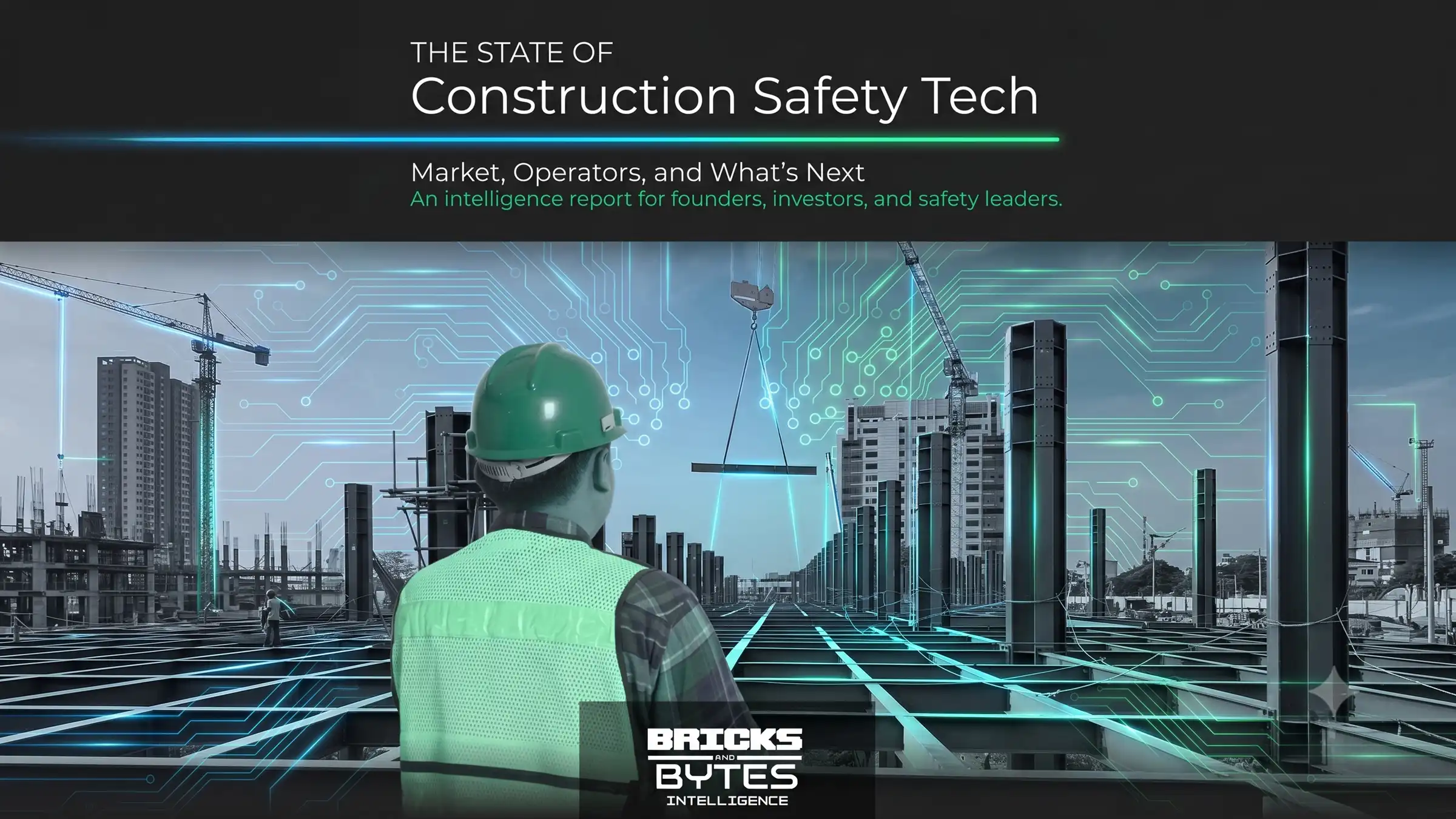
Construction remains the most dangerous place to work in the developed world. In the United States, roughly one in five worker fatalities in 2023 occurred in construction, and the leading causes have been unchanged for decades. The digital technology asked to address this has, for most of its history, recorded what happened on site rather than improving the work itself.
That assessment opens The State of Construction Safety Tech, a new intelligence report from Bricks & Bytes, the construction technology media and research platform behind one of the sector’s most listened-to podcasts. Pocketknife Group founder and Managing Director Cam Stevens is one of nine experts profiled in the report, and his thinking shapes its analytical foundations. This article summarises what the report covers, where PKG’s contribution sits within it, and why we recommend safety and technology leaders read it.
A report built from operator conversations
Over several months, the Bricks & Bytes team interviewed the founders, product leaders, and enterprise safety executives who are building, buying, and deploying construction safety technology. The result runs to more than 120 pages across three layers: a market layer covering category definitions, sizing, capital flows, and a seven-bucket category map; an operator playbook covering buyers, evaluation, pricing, and the adoption problem; and a forward view covering regulation, technology readiness, and three scenarios for what the market looks like in 2030.
The report is written for founders building in the category, investors forming a thesis on it, and the safety and operations leaders inside contractors, owners, and insurers deciding what to deploy. The expert case studies feature leaders from HammerTech, Navatech, Breadcrumb, and other operators across four continents, alongside Cam’s perspective from the advisory side. It is a serious piece of market intelligence in a category that has historically been long on vendor marketing and short on honest analysis.
A working definition of SafetyTech
The report’s central definitional question is one PKG has worked on for years: what actually is safety technology? The answer the report adopts is PKG’s definition:
“Safety technology is any technology that has the potential to improve the design of work, the experience of work, or the actual safety of work itself.”
— Cam Stevens, Founder, Pocketknife Group
This three-part framing structures how the report evaluates the entire category. The design of work is the upstream layer: planning, scheduling, method statements, and risk assessment. The experience of work is the worker-facing layer: usability, accessibility, and the friction involved in raising a concern. The safety of work itself is the intervention layer: technology that changes the interface between hazards and people. The report applies a simple test to any product claiming the SafetyTech™ label — which of the three does it actually affect? Many compliance platforms affect none of them directly.
Readers of this blog will recognise the framing. It is the same definition we published in April 2026, and it underpins how PKG evaluates technology with clients across construction, energy, resources, and utilities. Seeing it adopted as the analytical spine of an independent market report, written primarily for founders and investors, signals that the work-design view of safety technology is moving from a practitioner argument to market consensus.
The compliance gap
A second strand of Cam’s contribution addresses why so much deployed safety software disappoints:
“Traditional safety software often does not improve the design, experience, or safety of work itself. It captures data — data that is often poor quality because it’s based on lip service rather than true site conversations.”
— Cam Stevens, Founder, Pocketknife Group
The report develops this into what it calls the compliance gap: the distance between meeting a documentation objective and achieving a safety outcome. Its synthesis chapter finds that data quality over data volume is one of the consensus positions held by every operator interviewed, independently of one another. In an era where AI systems are trained and operated on this data, low-quality inputs produce confidently wrong outputs. The gap between recorded work and real work is where most deployment value evaporates.
The regulatory tide
The report credits Cam with leading its regulatory thread, which every other operator interviewed then echoed in some form. Australia’s reconceptualisation of workplace safety to include psychosocial risk became enforceable under Work Health and Safety law across most jurisdictions from 1 December 2025, with New South Wales moving its Managing Psychosocial Hazards Code of Practice to a legally enforceable benchmark from 1 July 2026. As Cam noted in his interview:
“Legislation has passed giving unions the right to inspect digital scheduling and planning tools for their psychosocial impact. That dramatically expands the scope of what a safety tech product might need to address.”
— Cam Stevens, Founder, Pocketknife Group
Alongside mandated site safety surveillance in Singapore and Hong Kong, the report treats these developments as early indicators of a broader expansion in what regulators consider safety’s legitimate scope: from physical hazards to psychological hazards, and from voluntary adoption to procurement-level mandate. For Australian organisations, this is the current operating reality. For the global vendors and investors the report addresses, it is a preview of where their markets are heading.
Why it is worth your time
The case study on Cam in the report opens with a distillation of the position PKG has held since its founding: safety technology fails when it is treated as a technology problem, and succeeds when it is treated as a work design problem that happens to use technology. That is Better Work, By Design, expressed through a market intelligence lens, and it is encouraging to see an independent research team arrive at the same conclusion after months of conversations across the category.
We recommend the report to safety leaders evaluating technology, to executives building digital strategies in construction and adjacent high-risk industries, and to anyone in the SafetyTech ecosystem who wants a grounded view of where the category is heading between now and 2030. The report is honest about where the evidence is strong and where judgement is doing more work, including points where the experts profiled disagree with one another. That candour is rare in this genre and is precisely what makes it useful.
The report is available as a free download from the Bricks & Bytes website.
For more on how PKG defines and evaluates safety technology, read What is SafetyTech? A Definition from the Safety Innovation Academy.
And if you are working through what these shifts mean for your organisation, most of our engagements begin with a conversation.