
In his three-part blog series on building transformation capability in WHS teams, Will Mosenthal, our Director of Transformation & Delivery, makes the case for WHS functions to establish a dedicated Safety Transformation Office.
Each post stands alone, but together they trace a path from team-level realities through to the institutional structures to deliver change in WHS teams.
Earlier in this series we set out the patterns and challenges we see for WHS functions trying to deliver complex change, as well as our views on what is needed at the team and leadership levels to enable it. We finished by acknowledging that even where this is starting to work, WHS functions running several projects at once nearly always have complex interdependencies between these projects, as well as with other functions such as IT, operations, HR and finance, that need careful management.
This final part in the series looks at a discipline that is well established in driving change in other functions but is often unfamiliar in safety – the Project Management Office (PMO). We explain what a PMO is and what it does, before making the case for where we think WHS functions can take these ideas further with a dedicated Safety Transformation Office.
What is a PMO?
The Project Management Institute defines a PMO in its PMBOK® Guide as “a management structure that standardises the project-related governance processes and facilitates the sharing of resources, methodologies, tools, and techniques”. While individual Project Managers drive the delivery of specific initiatives, a PMO ensures all projects align with broader goals and priorities, using standardised practices.
Typical responsibilities of a PMO include:
- Ensuring strategic alignment – managing the prioritisation of projects that support the organisation’s strategic vision and offer the best return on investment.
- Standardising processes – developing and managing the frameworks, templates and tooling used by project teams to ensure consistency.
- Keeping projects on track – monitoring key performance indicators and proactively managing stakeholder expectations when there are risks to timelines, cost or scope.
- Improving communication across stakeholders – managing the flow of information with regular reporting rhythms and facilitating the translation of technical project language into terms understood by the business.
- Driving benefits realisation – ensuring that projects deliver their intended business value by tracking value delivery post-implementation.
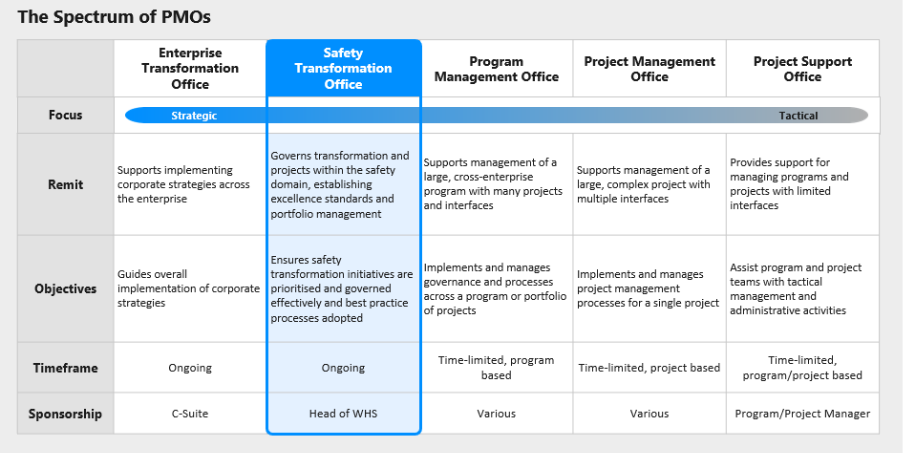
Not all PMOs are the same, and the differences between them generally come down to the authority and remit an organisation gives them as well as the seniority, skills and resources within the capability. On a spectrum of very tactical to highly strategic PMOs, a more tactical PMO might be largely administrative, providing templates, standards and reporting support to project teams. In the middle of the spectrum, it tends to be a controlling function, setting the standards that projects are required to follow and holding them to account. At the more strategic end, a PMO directs, shaping which projects happen at all, how they are sequenced and where the organisation’s investment is prioritised.
Where an organisation lands on this spectrum tends to be driven by the complexity of the portfolio it is managing, and by how much it is prepared to invest in its delivery capability.
The opportunity for a Safety Transformation OfficeTM
At PKG, we believe that modern WHS teams should aspire to developing a Safety Transformation OfficeTM (STO) – a PMO capability shaped specifically around the nuances of delivering complex change within WHS. The intent of the STO is to bring a WHS function’s major transformation work together, so that a portfolio of separate projects becomes a coordinated body of work with a single view and a home for governing change and managing cross-functional dependencies.
We see five core characteristics of an STO that are specific to delivering change in WHS:
- Built for continuous reprioritisation – a WHS portfolio is rarely stable and having a team that can react quickly when things change is a strength. Regulator requests, incident investigations and assurance obligations typically arrive at short notice. An STO drives agility in the team by being designed to absorb and support changing priorities rather than having progress derailed by them. Prioritisation and trade-offs decisions can be surfaced and facilitated quickly and consistently. The onward implications for timelines, scope and quality of project delivery are then understood and communicated appropriately.
- A higher bar on adoption – if a corporate finance or document management system rollout lands badly, budget may be overspent, executives and team members may be frustrated and reputations may be damaged. If a change to hazard reporting, permit-to-work or critical control verification system lands badly, the consequences can be catastrophic. An STO cannot treat go-live as completing the work and instead must govern the disciplined transition of project work into business-as-usual.
- Change that lands on the frontline – safety transformation almost always changes the work that supervisors or crews do and typically has an impact on the processes and/or technology they interact with. Those people are often shift-based, remote, contractor-employed, and may be working without corporate email or reliable connectivity. Generic project practice tends to assume an office-based population. An STO drives change management best practice, standardisation and is conscious to ensure that the realities of the frontline environment are built into the objectives of each project.
- Brokering across functions – safety data lives in HR, asset and work order systems as well as safety-specific platforms. Safety change usually requires close collaboration with an organisation’s other functions such as IT, operations, HR, procurement as well contracting partners external to the business. An effective STO needs to spend its time facilitating alignment with other organisational functions.
- Enhancing delivery capability in the team – as we set out earlier in this series, project and transformation delivery capability in most WHS teams sits at a relatively low level of maturity. A high-performing STO not only governs the portfolio but also lifts the delivery capability of the team around it. Over time, this ensures the WHS function gets progressively better at delivering change.
While an STO might be a small team or fronted by one individual, for it to work, the person leading the capability needs enough standing in the organisation to convene the right people and get decisions made. This means facilitating the governance, making sure trade-offs reach the person who owns them, and clearing the dependencies that individual project leads have no authority to resolve.
In the below Spectrum of PMOs, we have illustrated where we see an STO in the context of the range of PMOs we have described above. As a governing body and enabler for all strategic change within a WHS function, we see the STO at the more strategic end of this spectrum.
Questions we get asked on PMOs and STOs
Having tested these concepts with safety leaders, we tend to see some recurring questions come up.
How many people does it take to run a PMO or STO? Does this mean increasing the headcount budget in my WHS team?
The answer to this largely depends on the scale and complexity of the projects the WHS team is delivering, and the level of involvement and support required regardless of which end of the PMO spectrum the capability is operating at. In large, complex portfolios, a PMO or STO might be a small team, with different team members focused on different responsibilities, such as reporting, integrated planning and communications. In a smaller portfolio it might be one person covering several projects in addition to their BAU WHS responsibilities.
Some WHS teams might reskill or upskill existing team members, while others may bring in dedicated delivery skills to the team. All of these factors will vary the investment required to get a desired outcome from a PMO or STO. Ultimately, the delivery capability of the team members doing the project delivery will also impact the skills and time and effort allocation needed from a PMO or STO. While investment almost certainly will be required, we would encourage thinking about this holistically in terms of skill uplift and having the right blend of capabilities in the team rather than a singular headcount cost.
Does an STO need to be led by a safety professional?
Not necessarily. Someone who has already worked in the team or has a grounding in the work safety professionals do, the constraints they operate under, and the organisation’s safety technology environment brings a real advantage. However, PMO leadership is a long-established profession, and there are people who have had very successful careers running effective delivery capabilities in a range of functions and industries. Bringing different skills and experience into a WHS team is often exactly what enables change to get delivered. Some teams might upskill existing safety leaders into the role; others might bring in delivery professionals from outside the function.
We have low delivery capability in our WHS team – where do we start?
Our advice is to always start with the fundamentals rather than the structure. In most WHS teams, there are no consistent ways of working: no shared planning and inconsistent reporting templates. Standardising some of these basics across the portfolio is unglamorous, but it changes what leaders can see almost immediately. Safety teams without access to dedicated project management software can make a lot of progress with enterprise tools such as Microsoft Planner with Office 365, as well as using AI such as Microsoft CoPilot to drive consistency and efficiency in project delivery.
In addition to the fundamentals, look for delivery expertise you can borrow. Project management, business analysis and change management skills often already exist elsewhere in the organisation, particularly in technology functions. Partners and third parties can also augment the team where this isn’t a capability you want to build permanently in the team.
Conclusions – treat project delivery as its own discipline and invest in upskilling
Across this series we have set out the patterns that stall complex change in WHS functions, what we see working at the team and leadership level, and the case for managing that work in a consistent way.
Our core recommendation to safety leaders is to treat project delivery as a discipline in its own right rather than something absorbed on top of the day job. Small steps such as taking a consistent approach to planning and reporting and developing a shared language for risks and issues can make a huge difference. Equally important is investing in upskilling the team and/or bringing in the right skills to drive the objective of uplifting delivery capability.
If you are interested to discuss this or the other topics addressed in this series, please reach out to: will@pocketknifegroup.com.